
It’s official: the humble baked potato is having a moment.
For decades, jacket potatoes were the slightly beige option of the British lunch menu – wholesome, filling, but rarely something people would queue around the block for.
Fast forward to 2025, and suddenly spuds are the star of the show. Viral TikTok stars are fuelling queues at street food vans and new openings are drawing crowds that rival burger joints and ramen bars.
So what’s behind the baked potato renaissance? And why are we all so obsessed with spuds again?
The baked potato is about as simple as food gets. A potato, an oven, and some toppings, packaged hot and ready to eat. But as with so many things, social media has turned the simple into the spectacular.
Take Spud Bros, the Preston-born duo Jacob and Harley Nelson. From serving spuds out of a converted tram, they’ve built a following of 2.6 million TikTok fans and racked up an eye-watering 1.5 billion video views. Their feed blends high-energy service videos with creative toppings, and the results speak for themselves. By mid-morning, queues snake around the block, with customers flying in from as far as Orlando, Florida, just to get a taste.
Liverpool has just become the next chapter in their story, with SpudBros Express opening in Queen Square – their first site outside London. The brand has ambitious plans, eyeing 30 to 40 locations by 2027 and international expansion on the horizon.
“Liverpool has always been one of the UK’s most exciting food cities,” Jacob Nelson told trade site Propel. “It feels like the perfect place for our first SpudBros Express outside of London. What started as a humble family tram in Preston has turned into a movement.”
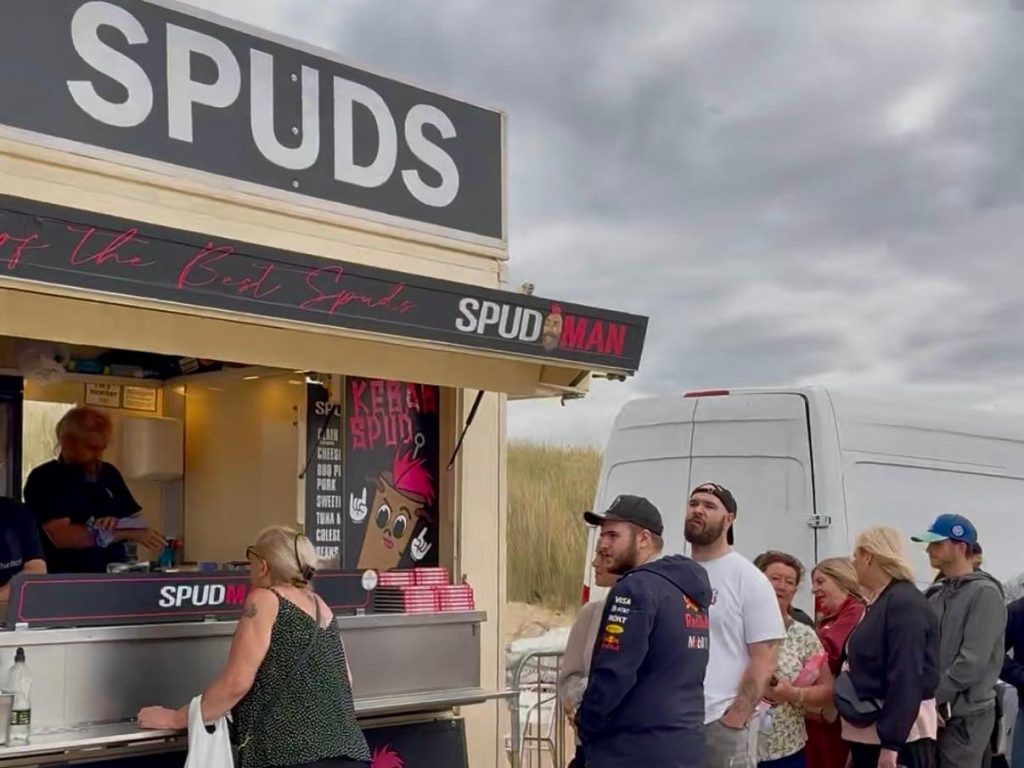
Of course, Spud Bros aren’t the only potato players in town. When Spud Man rolled up to Crosby Beach’s Bus Yard a few weeks ago, he brought with him a following of 4.2 million TikTok fans – and queues of up to 100 people.
Spud Man, real name Ben Newman, has become a national phenomenon. His twist? Classic jacket potatoes paired with fan interaction. Customers can bring their own toppings, which he theatrically adds to their order while filming for TikTok. Each potato becomes part of the show, and in turn, part of the algorithm.
It’s this blend of food and performance that seems to resonate with social media audiences, who are increasingly hungry for experiences, not just meals. For fans, meeting Spud Man in person is almost like attending a live gig. For Newman, it’s proof that even a simple spud can become the star of a viral empire.
For older generations, the sight of queues for jacket potatoes might bring back memories of Spud-u-like. Founded in 1974, the chain once had 50 outlets across the UK and was a staple of food courts throughout the 80s and 90s.
Spud-u-like rode the wave of fast-casual dining before the term even existed, offering quick, affordable potatoes topped with everything from tuna mayo to chili con carne. But after decades of expansion, acquisitions, and rebrands – including a short-lived revival with TV chef James Martin – the brand finally closed in 2024.
What Spud-u-like didn’t have, of course, was TikTok. The chain’s closure proved that nostalgia alone wasn’t enough to sustain it in a rapidly changing food landscape. Today’s potato entrepreneurs have tapped into a completely different model: combining low-cost ingredients with high-impact digital marketing.
Beyond the viral videos, there’s another reason why spud start-ups are multiplying: the numbers stack up, and fast. According to King Edward Potato Ovens, a baked potato business can generate profits in as little as a week. With ingredient costs as low as £1.15 for cheese and beans and average selling prices between £4.50 and £6.50, gross profits often top £4 per potato.
Sell 100 spuds a day, and you’re looking at nearly £150,000 profit a year. For a street food trader or small café, that’s serious money from a humble ingredient that’s been part of British diets for centuries.
What’s striking about this new potato wave is that it isn’t driven by culinary reinvention. The toppings – cheese and beans, tuna mayo, chili and curry – are mostly the same ones Spud-u-like was serving in 1995. What’s different is the stage.
TikTok, Instagram Reels, and YouTube Shorts have turned jacket potatoes into bingeable content. The slow reveal of a potato splitting open, the cheese melting into steaming flesh, the quick-fire banter with customers… These are perfect clips for short-form video platforms.
The algorithms reward personality as much as product, which is why sellers like Spud Bros and Spud Man thrive. They’re not just cooks; they’re entertainers, community builders, and marketers rolled into one. For fans, queuing becomes part of the experience, an act of belonging to the spud-loving community.
Liverpool is no stranger to food trends. From the city’s burger boom in the 2010s to the rise of artisanal coffee and now global recognition for its independent food scene, it has always been quick to embrace the next big thing.
The arrival of Spud Bros Express cements Liverpool’s place in the current potato craze. With its mix of locals, students, and tourists, Queen Square is a prime spot for viral food culture. Expect long queues, plenty of TikTok clips, and perhaps even a few international visitors who’ve flown in to tick “Spud Bros Liverpool” off their foodie bucket list.
Liverpool’s queues are proof: the potato is no longer just comfort food – it’s a cultural moment. And for once, it’s not chips or crisps in the limelight, but the good old jacket spud. And who knows – perhaps the city’s creative streak will inspire its own home-grown potato entrepreneurs, ready to give the Nelson brothers and Spud Man a run for their money.